







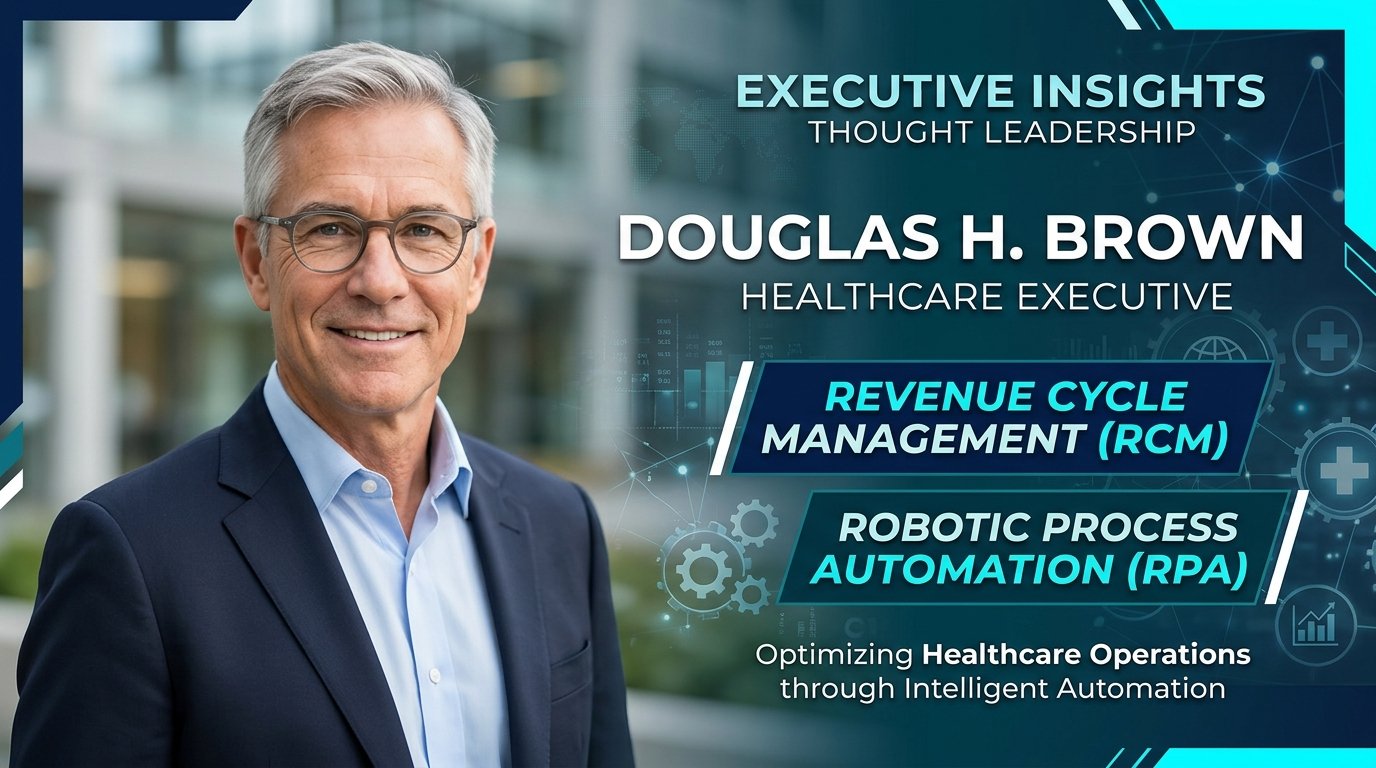
Healthcare organizations across the United States are increasingly focused on improving financial operations, reducing administrative workloads, and adopting technology that makes everyday processes more efficient. Revenue Cycle Management (RCM) and Robotic Process Automation (RPA) are two important areas driving this transformation.
The search term Douglas H. Brown healthcare executive RCM RPA posts brings together an individual’s professional identity and two significant healthcare technology topics. However, publicly available information reviewed for this article does not establish a sufficiently verified professional biography or an authenticated collection of posts belonging to a specific Douglas H. Brown in this field.
Understanding this distinction is important when researching healthcare executives and their professional contributions. Rather than attributing unverified opinions or publications to an individual, this article examines the healthcare management concepts associated with the search and explains how RCM and RPA influence modern healthcare organizations.
It also explores the practical considerations healthcare executives should understand when evaluating automation, financial performance, and operational improvements.
Who Is Douglas H. Brown in Healthcare?
Douglas H. Brown is the individual named in the search query, which associates his name with healthcare executive leadership, Revenue Cycle Management, and Robotic Process Automation.
However, a reliable professional profile connecting this exact individual to those responsibilities could not be independently established during the research for this article.
This distinction matters because multiple professionals can share the same name. A physician, financial professional, technology executive, and healthcare consultant may have similar public search results without having any professional connection to one another.
Before attributing specific achievements or opinions to Douglas H. Brown, readers should verify:
- His current or previous professional position.
- The healthcare organization or company associated with him.
- His experience in revenue cycle operations.
- His involvement in healthcare automation initiatives.
- His authenticated professional publications or social media posts.
- Any documented presentations, interviews, or industry contributions.
An accurate executive profile should rely on identifiable professional records rather than assumptions based on keyword associations.
What Is Revenue Cycle Management in Healthcare?
Revenue Cycle Management is the collection of administrative and financial processes healthcare organizations use to manage payments for the services they provide.
RCM begins when a patient schedules an appointment or registers for treatment and continues through billing, insurance claims, payment collection, and account reconciliation.
An effective RCM process helps healthcare providers maintain financial visibility while reducing avoidable administrative problems.
Important Components of Healthcare RCM
1. Patient Registration and Insurance Verification
The revenue cycle begins with accurate patient information.
Healthcare staff collect demographic details, insurance information, and other necessary records. Insurance eligibility verification helps determine whether coverage is active and whether additional requirements may apply.
Incorrect information at this stage can create problems later in the billing process.
2. Medical Coding and Charge Capture
Medical coding translates documented healthcare services into standardized codes used for billing and reimbursement.
Charge capture ensures that services and procedures provided by healthcare professionals are appropriately recorded.
Accurate documentation and coding are essential for supporting claims and reducing preventable billing errors.
3. Claims Submission
Healthcare organizations submit claims to insurance companies and other responsible payers.
Claims must contain appropriate patient, provider, service, and billing information.
Errors or missing information can result in rejections, requests for additional documentation, or payment delays.
4. Payment Posting
Payment posting involves recording payments received from insurance companies and patients.
The process also includes reconciling payment information with outstanding accounts and identifying differences between expected and received reimbursement.
5. Denial Management
Claim denials occur when an insurance payer refuses to reimburse a submitted claim, either partially or completely.
Revenue cycle teams investigate denial reasons, correct errors when appropriate, submit appeals when justified, and identify recurring problems.
6. Accounts Receivable Management
Accounts receivable represents payments owed to a healthcare organization.
Effective management involves monitoring outstanding balances, following up on unpaid claims, resolving discrepancies, and improving collection processes.
What Is Robotic Process Automation in Healthcare?
Robotic Process Automation, commonly called RPA, uses software robots to perform repetitive, rule-based tasks through digital systems.
Unlike physical robots, software robots operate within applications, websites, databases, and computer interfaces.
Healthcare organizations can use RPA to reduce repetitive administrative work and improve the consistency of routine processes.
RPA does not automatically replace clinical judgment or complex decision-making. Its primary purpose is to handle suitable tasks that follow predictable rules.
Common RPA Applications in Healthcare
Automated Patient Data Entry
Software robots can transfer information between compatible systems when the workflow and permissions allow it.
This can reduce repetitive manual entry and help staff manage administrative information more efficiently.
Insurance Eligibility Verification
RPA can assist with checking insurance eligibility by accessing designated payer portals and transferring verification results into approved systems.
Human review remains important when information is incomplete or coverage requirements are unclear.
Claims Status Checking
Revenue cycle employees frequently need to check the status of submitted insurance claims.
Automation can assist with repetitive status inquiries, retrieve available information, and update internal records.
Payment Posting Support
RPA can help transfer payment information from electronic files or payer systems into billing applications.
Organizations must establish appropriate reconciliation controls to identify discrepancies and prevent inaccurate account updates.
Denial Identification
Automation can assist with identifying recurring denial codes and organizing claims that require additional attention.
However, determining the correct response may require coding expertise, payer-policy knowledge, and human judgment.
Report Generation
Healthcare organizations can use automated workflows to collect information and prepare routine operational reports.
This can help managers monitor important performance indicators without repeatedly gathering the same information manually.
How RCM and RPA Work Together
RCM and RPA serve different but complementary purposes.
RCM provides the financial and administrative framework for managing healthcare revenue. RPA provides a way to automate selected activities within that framework.
When properly implemented, automation can make repetitive RCM processes more consistent and reduce unnecessary manual work.
Consider a hypothetical healthcare organization that processes a large number of insurance claims.
Its employees may spend considerable time checking claim statuses, reviewing payment information, and updating billing records.
An appropriately configured RPA solution could perform selected routine tasks while directing exceptions to experienced revenue cycle employees.
A simplified workflow might look like this:
- Patient and insurance information enters the organization’s system.
- Eligibility verification is performed.
- Healthcare services are documented and coded.
- Claims are prepared and submitted.
- Automated workflows retrieve eligible claim-status updates.
- Payment information is transferred for reconciliation.
- Unusual transactions are flagged for human review.
- Revenue cycle managers monitor performance and investigate recurring problems.
The objective is not to automate every decision. It is to make the overall workflow more efficient while preserving appropriate oversight.
Benefits of RPA for Healthcare Revenue Cycle Management
Healthcare automation can provide operational benefits when organizations select suitable processes and establish effective controls.
1. Reduced Repetitive Administrative Work
Revenue cycle employees often perform the same digital activities throughout the working day.
RPA can handle suitable repetitive tasks, allowing employees to concentrate on exceptions, complex accounts, and activities that require communication or professional judgment.
2. More Consistent Workflows
Human employees can perform repetitive tasks differently, especially when processes involve multiple systems.
A properly configured automation workflow follows established instructions consistently.
However, consistent automation does not guarantee accurate results if the original rules or data are incorrect.
3. Improved Operational Visibility
Automated workflows can generate records of completed activities, failed transactions, and exceptions.
These records help managers understand where processes are working and where additional investigation is necessary.
4. Support for Faster Administrative Processing
Automating selected tasks can reduce delays caused by repetitive data transfers and routine system interactions.
The actual improvement depends on system performance, workflow complexity, and the quality of implementation.
5. Better Use of Employee Time
Healthcare employees have responsibilities that require communication, analysis, and problem-solving.
Reducing repetitive administrative activities can give teams more time to address complex billing questions and patient account concerns.
6. Greater Process Standardization
Automation encourages organizations to document workflows and define consistent procedures.
This can help healthcare organizations identify unnecessary steps and improve operational accountability.
Challenges of Implementing RPA in Healthcare
Although automation offers potential advantages, implementation requires careful planning.
Integration With Existing Healthcare Systems
Hospitals and medical practices often use multiple software platforms.
These systems may have different data formats, interfaces, and access requirements.
An RPA solution that works with one application may not integrate easily with another.
Healthcare organizations should evaluate compatibility before selecting an automation platform.
Data Accuracy
Automation depends on the information it receives.
If patient records, insurance details, or billing information are inaccurate, automated workflows may repeat or distribute those errors.
Data validation should therefore be part of every important automation process.
Privacy and Security
Healthcare organizations handle sensitive patient information.
Automation systems must be designed with appropriate access controls, security measures, monitoring, and compliance procedures.
Organizations subject to HIPAA must evaluate how automation vendors and workflows handle protected health information.
Changing Payer Requirements
Insurance companies may update their billing policies, documentation requirements, and claim-processing procedures.
Automation rules must be reviewed and maintained when these requirements change.
Outdated workflows can create avoidable errors.
Employee Training
Successful automation requires cooperation between technology teams and revenue cycle employees.
Staff should understand which activities are automated, how exceptions are handled, and when manual intervention is necessary.
Implementation Costs
Automation requires more than purchasing software.
Organizations should account for implementation, integration, maintenance, testing, training, and ongoing governance.
A solution that automates an inefficient process without correcting its underlying problems may produce disappointing results.
What Healthcare Executives Should Evaluate Before Adopting RPA
Healthcare executives should approach automation as an operational improvement initiative rather than simply a technology purchase.
The following considerations can help organizations evaluate whether an RPA project is appropriate.
Identify the Right Processes
Start by examining repetitive activities that consume substantial employee time.
Potential candidates include:
- Insurance eligibility checks.
- Routine claim-status inquiries.
- Repetitive data transfers.
- Payment information processing.
- Standardized report generation.
- Administrative document handling.
Processes involving unpredictable decisions or complex patient-specific circumstances generally require greater human involvement.
Establish Clear Performance Metrics
Before implementing automation, organizations should establish a baseline.
Useful measurements include:
- Average claim-processing time.
- First-pass claim acceptance rate.
- Claim denial rate.
- Days in accounts receivable.
- Cost to collect.
- Manual processing hours.
- Payment posting accuracy.
- Automation exception rate.
These indicators help managers determine whether an automation initiative is producing meaningful operational improvements.
Prioritize Data Security
Healthcare executives should evaluate how an automation platform accesses, stores, transfers, and processes sensitive information.
Important considerations include user permissions, audit trails, vendor agreements, system security, and incident response procedures.
Maintain Human Oversight
Not every billing or reimbursement decision should be automated.
Employees should review unusual claims, disputed payments, complex denials, and transactions involving unclear information.
Human oversight is especially important when an automated workflow could affect patient access, billing accuracy, or financial outcomes.
Measure Return on Investment
An automation project should have a clearly defined business case.
Organizations can compare implementation and maintenance costs against measurable improvements in productivity, processing time, error rates, and operational expenses.
The assessment should consider both direct financial benefits and the value of employee time.
The Relationship Between Healthcare Automation and Financial Performance
Healthcare financial performance depends on multiple operational factors.
Technology can support better performance, but successful revenue cycle management also requires accurate documentation, effective communication, trained employees, and appropriate financial controls.
For example, automating claims submission will not necessarily solve a recurring coding problem.
Similarly, automating payment posting cannot independently resolve every payer reimbursement discrepancy.
Healthcare executives should examine the complete revenue cycle before deciding where automation will have the greatest practical value.
A useful approach is to identify the underlying cause of a problem before introducing technology.
If repeated claim denials result from incorrect patient information, improving registration and verification processes may be more important than automating denial follow-up.
If employees spend substantial time transferring information between applications, an appropriately designed automation workflow may be a better solution.
The distinction between these situations helps organizations invest in technology that addresses actual operational needs.
How to Evaluate Douglas H. Brown Healthcare Executive RCM and RPA Posts
Readers searching specifically for Douglas H. Brown healthcare executive RCM RPA posts should distinguish between verified professional content and general healthcare automation information.
A professional post should not automatically be attributed to someone simply because the name appears alongside healthcare terminology.
Use the following approach when evaluating relevant publications.
1. Verify the Author’s Identity
Check whether the professional profile includes a consistent name, employment history, organization, and relevant healthcare responsibilities.
A verified identity helps reduce confusion between professionals with similar names.
2. Examine the Professional Context
Look for evidence that the individual has experience with healthcare operations, financial management, technology implementation, or revenue cycle processes.
The relevance of a post depends partly on the author’s professional background.
3. Evaluate the Content
A useful healthcare technology publication should explain a clear issue or idea.
For example, relevant subjects may include:
- Revenue cycle transformation.
- Healthcare billing automation.
- Claims processing improvements.
- RPA implementation strategies.
- Healthcare financial management.
- Administrative workflow optimization.
- Technology integration challenges.
These are relevant research topics, not verified subjects of publications by Douglas H. Brown.
4. Check Publication Dates
Healthcare technology and administrative requirements change over time.
Older posts may provide useful historical context, but readers should verify whether the information remains applicable.
5. Distinguish Personal Opinions From Established Facts
A professional post may express an individual’s opinion about a technology or industry trend.
That opinion should not be presented as an official recommendation, scientific finding, or regulatory requirement without additional evidence.
This distinction is particularly important when evaluating healthcare automation claims.
The Future of RCM and RPA in the US Healthcare Industry
Healthcare organizations continue to explore ways to modernize administrative operations.
Electronic information exchange, workflow automation, interoperability, and improved data management are important parts of this process.
The Centers for Medicare & Medicaid Services has also advanced administrative simplification through standards for electronic healthcare claims attachments and related transactions.
These developments illustrate the importance of reducing unnecessary paperwork and improving information exchange between healthcare providers and payers.
Several areas deserve continued attention.
Greater Administrative Interoperability
Interoperability allows different healthcare information systems to exchange and use data.
Improved interoperability can reduce manual information retrieval and help organizations coordinate administrative processes.
More Intelligent Workflow Automation
RPA can manage repetitive tasks, while other technologies may support document recognition, data extraction, and more advanced workflow analysis.
Healthcare organizations should distinguish between traditional rule-based automation and artificial intelligence because they have different capabilities and risks.
Stronger Data Governance
As automation expands, organizations need clear policies covering data quality, permissions, security, monitoring, and accountability.
Patient-Focused Financial Operations
Administrative efficiency should ultimately support better healthcare experiences.
Clearer billing, more accurate claims, and timely insurance processing can help reduce unnecessary confusion for patients and healthcare staff.
Responsible Use of Technology
Automation should support appropriate human decision-making rather than replace necessary professional judgment.
Healthcare leaders must consider accuracy, fairness, privacy, and the potential consequences of automated decisions.
Conclusion
The search for Douglas H. Brown healthcare executive RCM RPA posts connects an individual’s professional identity with two important areas of healthcare transformation.
Although a verified collection of publications or a definitive professional biography for the specific individual could not be established during this research, Revenue Cycle Management and Robotic Process Automation remain valuable subjects for understanding modern healthcare administration.
RCM helps healthcare organizations manage billing, claims, reimbursement, and financial performance. RPA can support selected repetitive processes, reduce manual administrative work, and improve workflow consistency when implemented responsibly.
For healthcare executives, the most important consideration is selecting automation opportunities based on real operational problems, measurable objectives, reliable data, and appropriate human oversight.
Readers researching Douglas H. Brown should verify professional identity and publication ownership before attributing specific healthcare opinions or achievements to him.
Understanding the relationship between healthcare financial operations and automation provides a useful foundation for evaluating industry developments and making informed technology decisions.
Explore More:Briana Biagi: Banner Health Patient Access in Fallon











Discussion about this post